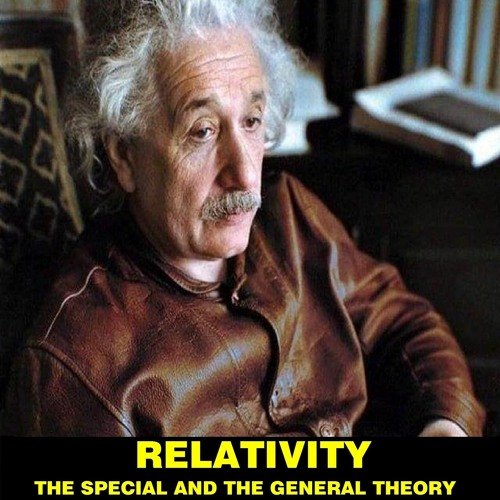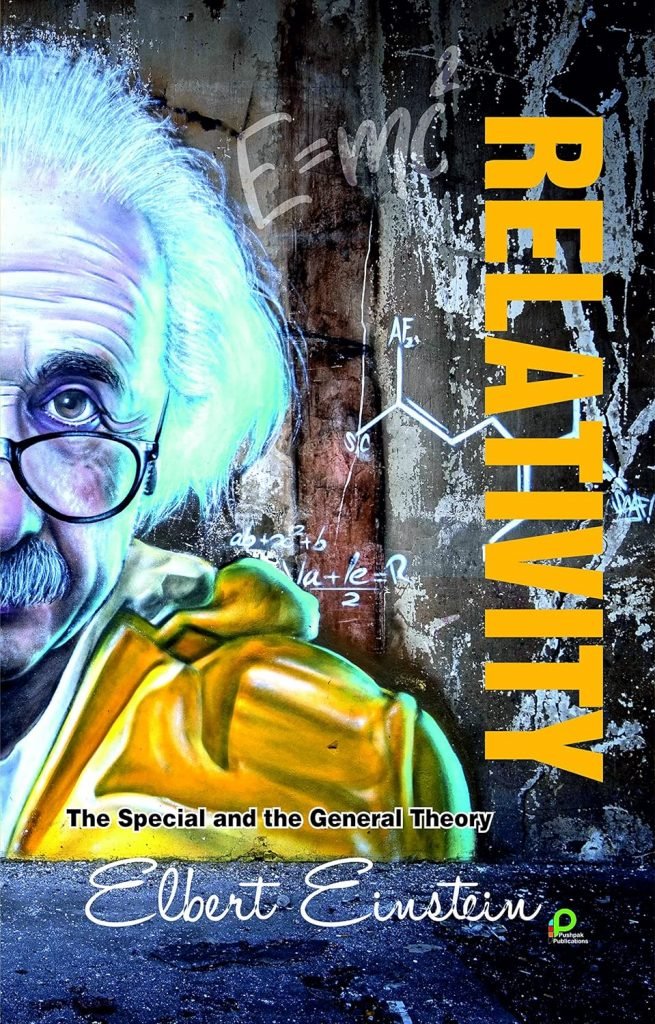
Relativity: The Special and General Theory, is an exact complete understanding of the theory of Relativity. It is the perfect material of study for learners, who have a general scientific and philosophical point of view, are interested in the theory of theoretical physics.
It is a compilation of short papers turned into a book that was originally written in German and then published in English in 1920. Einstein mentions the main aim of the book is to take the concept of relativity even to people with
no strong background in Physics. The book has three major parts. In the first part, concepts like coordinate systems, length contraction, time dilation, relativistic mass, Minkowski’s Four-dimensional Space have been elaborated. Followed by, a revolutionary concept of general relativity is discussed in the second part. Lastly, Einstein puts light on his philosophical perspective towards the universe; also the way physics defines the working manual of it.
About the Author
Albert Einstein the famous German physicist, developer of the special and general theories of relativity, pioneering many key developments. He is cited as one of the most influential scientists of the 20th century. His work plays the most important contribution for astronomers to study everything from gravitational waves to Mercury’s orbit.Regarded as the founder of modern physics,
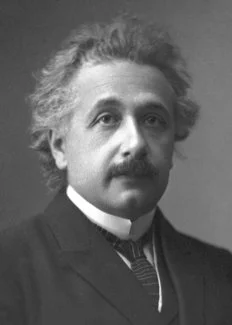
Albert Einstein was born to Hermann Einstein, a salesman and an engineer, and Pauline Kochon on 14 March 1879, in Ulm, Kingdom of Wurttemberg, German Empire. He received his education at the Luitpold Gymnasium in Munich. His grades in physics and mathematics were always excellent. He completed his schooling at the Argovian Cantonal School, Aarau, Switzerland, and at the age of seventeen he joined the Zurich Polytechnic for a physics and mathematics teaching diploma programme.
Einstein received his degree in 1900 but failed to get a suitable teaching job. With his friend’s help. he joined the Federal Office for Intellectual Property as an assistant examiner-level III. Einstein secured a permanent position at the Swiss Patent Office in 1903. His conclusions about the space-time connection and the nature of light were aided by his work and experiments during this job.
Einstein completed his Ph.D. from the University of Zurich in 1905 and published four papers in the scientific journal named Annalen der Physik. The year was miraculous for him as these papers on photoelectric effect, Brownian motion, special relativity, and mass-energy equivalence (E = mc2) were significant contributors to the foundation of modern physics. They reformed the views on time, space, and matter. In the next few years. Einstein came to be recognized as a major scientist.
In 1908 he joined the University of Bern as a lecturer and the next year he was appointed as an associate professor at the University of Zurich. Two years later. in 1911, he was appointed as a professor at the Charles- Ferdinand University, Prague. Here he wrote several scientific works.
Einstein returned to Zurich the next year, and for the two years that followed, he joined ETH Zurich as a professor of theoretical physics.
Einstein was appointed as the director of Kaiser Wilhelm Institute of Physics in the year 1914 and as the president of the German Physical Society in 1916. He developed the general theory of relativity between 1907 and 1915. It was published in 1915. In 1916, Einstein published Relativity: The Special and the General Theory in German. Its first English translation was published in 1920. Divided into three parts, the book deals with the special theory of relativity, the general theory of relativity, and the considerations on the universe as a whole. It is considered a groundbreaking scientific work.
In 1921, Einstein was awarded the Nobel Prize in Physics “for his services to Theoretical Physics. and especially for his discovery of the law of the photoelectric effect.” In the years that followed, he
travelled extensively. In 1933, he joined the Institute for Advanced Study in the United States, and by 1940 he became an American citizen.
Einstein published numerous scientific and non- scientific works. Some of his published works include Sidelights on Relativity (1922), Cosmic Religion: With Other Opinions and Aphorisms (1931), Essays in Science (1934), The World as I See It (1949). Out of My Eater Years (1950), and Ideas and Opinions (1954). Einstein died on 18 April 1955, aged seventy-six, in Princeton, New Jersey.
PREFACE